I have started to put together my lesson plans and resources for my Year 9 students. We follow the AQA specification and have in the classroom the Oxford AQA Textbook as a resource, and from which I have used the images.
I am trying to also develop duel coding and so have made use of the icons feature in power-point.
The flow of the lesson…
Slide 1 – Mind Map climate change – Helps to bring up memories they already have. Can also act as a helpful AfL to see misconceptions etc..
Slide 2 & 3- Link to the specification we follow, and also embedding the BUG concept of de-coding the question in the exams.
Slide 4 – 5 Using the image from the Oxford Textbook and blanked out to focus on the Specification content, we discuss the patterns..
Slide 6 – What happens next? Gets the students to think about the pattern rather than just being given it.
Slide 7 – Surprise!… The pattern has changed – Why might that have been?
Slide 8 – Focus on the last 200 years – Describe the pattern again. I do highlight and explain the colour coding.
Slide 9-11 Can the students now put all of the their learning together to describe the change in climate over the Quaternary period? Good AfL opportunity.
Slide 12 Another AfL opportunity – Seek and destroy… How can this answer be improved? Helps students who need more structure.
Slide 13 – Bring the lesson full circle how does their mind map need changing?
I started taking part in Parkruns on the 22nd of August 2015 and have since then completed 108 parkruns. Most of my parkruns have now taken place in Billericay and the beautiful Lake Meadows Park.
As a geography teacher, it is sometimes hard to switch off and not see the world through my geography glasses, and doing parkruns is no different. In this brief post I shall explain how I see the Billericay Parkrun through the eyes of a geographer!
Cresswell (2015) says that places are spaces that people have made meaningful or have an attachment to in some way. This builds on the work of Agnew (1987) who said that place includes three things; location, locale, and sense of place.
Location is where the place is in the world – the coordinates of the place. For Billericay Parkrun that start is at 51°37’56.9″N 0°25’09.1″E while the finishing line is roughly here 51°38’01.0″N 0°25’06.9″E – Next time I shall get the GPS out and make a note of the coordinates. The Billericay Parkrun website makes use of location, for example through the map of the course and also the directions to get there.
Getting there on foot The park has five points of access. The main entrance and nearest to the start / finish area is via Radford Crescent. Access is also available via the following residential roads surrounding the park: Lake Avenue, Hillhouse Drive, Perry Street and Knightsbridge Walk. The gathering point for the run is on the main field, just 25m from the cafe.Getting there by road Lake Meadows Park is situated in the heart of Billericay accessed via Radford Crescent. If using SATNAV, the nearest postcode is CM12 0BW. The town lies between the A12 and A13 arterial roads and is approximately 9 miles (14.5 km) east of the M25 (nearest junctions J28 or J29).
Locale is seen as the physical shape of a place – the natural processes that have shaped the area. Billericay Parkrun can been seen through this lens as a 3.8 lap run (not a race) around a lake – the run is mainly on tarmac paths but also on grass. The locale would also include the gradient of the course. At Billericay Parkrun tha course is not flat, there are gradients – and according to my Garmin watch, the maximum elevation is 80 m and maximum elevation gain is 43 m. The course passes different trees, ranging from oaks and beech to Cherry trees.
My effort at being artistic
Sense of Place – This is the attachment to a space that people have. The emotion that the space generates. From my geographical perspective there is lots of evidence of this taking place in Billericay Parkrun. One such example is the naming of a particular corner of the course “Sophie’s Corner” after Sophie, one of the young volunteers who week after week helps dad and gives everyone a high five! During the week, this part of the park is just a bend in the path, but come a Saturday, mention to any of the runners Sophie’s corner and they all know where it is.
Then we have the “hill” Thankfully we only need to climb the “hill” three times, but again, if you mention the “hill” to Billericay parkrunners they know where you mean. There is the shared emotion of the “hill” being hard and draining, but once you have done it that third time, it is overcome!
We can then see another type of place that has recently developed – a media place – Where the world of TV and parkruns combine. The world of Gavin and Stacey where Gavin and Billericay boy meets and falls in love with a Barry Island girl named Stacey. It just so happens that both places have a parkrun, and now in both parkruns there are signs that tell you how far each run is from the other, using the catch phrase from the show. Get a photo which each sign and you have just earned a Parkrun Tourist Gavin and Stacey badge!
Above all, as I run each week, the sense of place I get from running here is best described as fun and family. People in all shapes and sizes, all speeds fast or slow from runners to walkers and able to come together as one big parkrun family and enjoy the park and each others company. Achievements are recognised – not through speed, but just by taking part and being there. People wear their T-Shirt achievements with pride.
When I start planning lessons for my GCSE groups, I always start with the specification, as this informs me what areas I need to address and the content that examiners are going to focus on when writing exams. I follow the AQA Geography specification and this is what needs to be covered at GCSE level…
I then look through different textbooks and past papers for examples of exam style questions. At work, we use the exampro service, which we find excellent and so easy to use. I do this to really try and get into the minds of the examiner and think about how they are viewing the content. It is also really helpful as there will often be different types of images and figures that are used in the exam that I might not have considered using. Here are some typical exam type questions, from a range of sources for climate change that I have come across are:
Explain how volcanic activity and orbital changes may cause long-term climate change.
Outline one strategy which aims to reduce the rate of climate change (mitigation).
Explain why international directives are needed to reduce carbon emissions.
Describe local responses to the threat of global climate change.
Describe the possible effects of climate change on the UK.
Describe and explain the global response(s) to the threat of climate change
Climate change has global consequences. Describe the environmental and economic consequences of climate change for the world.
All of these questions require the students to think in different ways. Some ask the student to recall information, the AO1 knowledge and AO2 Understanding. Others when using images might tackle AO3 Applying knowledge and Understanding, while others might require students to select information AO4. It is therefore important that when planning lessons for my students, that I too offer this range of different requirements.
An example of a starter I use at the start of the GCSE module on Climate Change is shown below.. I ask students to study the graph – produced by NASA and available here and to then predict what happens next, based on historical records and evidence. Students are given a copy of the graph and the x axis extended to include a further 200,000 years. The discussions that the graphs generate really helps to kick start the climate change lessons.
By using data like the graph above, it leads nicely into the idea of natural causes of climate change, as well as providing a temporal context to the issue, which is where the lesson develops and moves onto.
It is also really helpful in developing the language of the lesson, so I check that students are aware what millennia means for example.
How do you approach planning GCSE lessons from the specification, I would love to hear your thoughts..
As you may have read, I have recently completed the UN Climate Change Teacher course. The next step my my professional development, and also in ensuring the course has lasting impact is to incorporate the materials into my teaching. With this in mind, I thought I would share with you what I have done so far in relation to A Level geography.
The image has been taken from the AQA Geography specification available here – I decided to focus on the role of the UN here, and their role in climate change. So where to start? Well, I decided to use the material from the Paris agreement, as I felt the Paris Agreement was a really good example of an attempt at global governance, and the issues that are associated with it.
I began by looking at the aims of the Paris agreement aims. All of the quoted text below has been taken from the Take away summary resource
The Paris argeement aims to
The goals of the Agreement are to keep global temperature rise well below 2°C above pre-industrial temperatures while pursuing efforts to limit it to 1.5°C
By including this in the aim of the Paris agreement, there is a desire to develop a series of social norms which will in turn help to reduce global temperature rise.
These goals are to be achieved in a manner that reflects equity and the principle of common but differentiated responsibilities and respective capabilities, in the light of different national circumstances.
Here the concept of common goals but taking into account the level of development of the countries involved is outlined in the Paris agreement. This is an area that I wish to explore further with the students, as this will allow deep thinking about why common goals are important, but also why differentiated responsibilities and capabilities are needed in order for global governance to work in practice. I shall also explore why the Paris Agreement has moved away from defining countries as either developed or developing.
This idea of differentiated actions is further explored here
The Agreement emphasizes the capacity building needs of countries with the least capacity, such as least developed countries (LDCs), and those that are particularly vulnerable to the adverse effects of climate change, such as small island developing States (SIDS), to help them take effective climate change action including on mitigation, adaptation, technology development and transfer and to access climate finance
This will further stimulate and provide an opportunity for students to investigate one of these SISS, and investigate:
Why it is at risk from climate change.
What mitigation is taking place.
How is adaptation taking place.
Which developed countries are supporting them.
When looking at how the Paris Agreement can regulate global systems, I shall draw the students attention to how the Paris agreement works, and what is expected from each country that has signed up to the agreement, in short:
Countries are expected to communicate Nationally Determined Contributions (NDCs) detailing actions towards meeting the goal of the Agreement every five years. Each new NDC should represent an increase in ambition
I shall ask students to explore the NDCs of a selection of countries found here and consider to what extent (exam style) th NDCs are similar and how effective they might be.
Also linked into the concept of globalisation and the flow of finance, the Paris Agreement encouraged globalisation in this sense as
Developed countries will provide finance to developing countries to assist them with their mitigation and adaptation efforts, and will report their public financial contributions to developing countries in a detailed manner every two years. Developing countries may also voluntarily provide support.
I will ask students to consider the roles here. It is right that “developed” countries are expected to provide finance to “developing” countries?
I will finish this section by asking students to consider how the Paris Agreement can be enforced when there is a non-punitive approach. Is this possible? This ties into the idea of “Issues” in the A Level Spec.
An implementation and compliance mechanism is established, consisting of a committee of experts, to facilitate implementation of the provisions of the Paris Agreement in a transparent and non-punitive manner, and promote compliance with the Paris Agreement.
This will be further explored as I introduce to the students who signed and who did not sign. Does this cause an issue, and if so why?
I was in two minds whether to submit a press release to let the local community know about my UN climate change teacher achievement. On the one, it would be great to let people know that teachers do learn after hours and are passionate about their subject, but on the other hand, would people really be that interested in what I did over several weekends?
So, encouraged by others on the Climate Change Teachers facebook page, I downloaded the press release and edited it slightly to reflect my school situation. I then asked the lovely Miss Chudleigh our Subject leader for History to use her amazing photography skills to take a photo or two. A few emails later and the press release was on its way to our local newspaper.
I then get a reply from the reporter, asking me to answer a few questions, which were,
what is he telling them to do to save the planet? What are in his lessons? What do kids get out of it?
My reply to those questions were,
In terms of the lessons that we are delivering, it is very much looking at the causes of climate change to begin with, both the natural causes and the human influenced causes. We begin by looking at the long term evidence of climate change, the photo by my whiteboard was highlighting the evidence that climate change on the planet is a natural event that has occured for thousands of years, resulting in ice ages for example. We then move on to look at the human causes of climate change. Evidence that Co2 concentrations have increased dramatically from 1950 levels for example going from 280 parts per million to around 400 parts per million. We present this evidence to students so students can see that never in our history has C02 been so concentrated in the atmosphere. We link this to burning of the fossil fuels. We then move on to the impact that climate change will have on people. We start locally, how will it affect the students lives for example. Will they be able to buy a fossil fuel run car in the future for example, or will they have to limit air travel in the future. After undertaking the UN course, I have now also been made aware of how climate change affects people very differently according to their gender – for example women when displaced due to climate related hazards in LIC ( Low Income Countries) are more likely to suffer from hunger as they tend to ensure food is their for their children rather than themselves. In terms of what I am telling students to do to save the planet. Well, I think it is deeper than that, I am hoping that by providing a climate change education through geography, we are giving the students the tools to be agents of change in the future. They will be better informed to make changes to their lifestyles, for example thinking about their energy supplier, considering the impact of always upgrading a mobile phone, and considering how their future lives can be more sustainable. In the short term, I talk about recycling, we have recycling bins in our classrooms, also about how students use paper, can it be reused instead of thrown away for example. I think it is important that instead of telling students this is what you need to do, instead we encourage them to think about what they could do, so the action and desire to change comes from them. What do the kids get out of it. Well once I have fully integrated the UN materials into my lessons, which will be in place by September, the students will be getting up to date and relevant information based on current research. The students are generally interested in the climate change issue and are keen to make a difference.
This was then used to produce the press article you can see at the top of the blog and can be visited below.
The Impact was quite amazing really. I was not sure when the article was going to be published, and so I was surprised when on Wednesday night I logged into Facebook at about 9pm to see what was happening in the world to see 20 notification. I normally get one or two… When checking them, I was greeted with the link to the newspaper article that had been shared by many of my colleagues at work congratulating me. Last time I had a news article published was way back in 2005 so facebook and social media was not really as big back then.
On returning to work on the Thursday, I am greeted by many students congratulating me, and in typical student fashion saying
I saw you in the newspaper / on facebook last night sir. So what have you done then?
This was great as I was able to have a conversation with students about the course, and for those that I teach in year 8, link it back to what we have been learning in class over the last two weeks. The sixth form students were impressed it was a UN scheme and I have had students come and ask me how they can get involved with recycling around the school. We now planning to relaunch the eco-committee shortly on the back of this. I also got a letter passed onto me inviting the school to a local action group meeting taking place soon asking what our local area can do to tackle climate change. Lots of colleagues starting taking about recycling at work, and what we do and don’t do, and how passionate they are about climate change too.
So what did the press release do:
Started the conversation about climate change in school
Added a greater importance on our climate change lessons that we are delivering
Starting to get people thinking about what action we can do in school to reduce waste.
Hopefully this is just the start of making a difference.
After about 5 years, I was finally in the position in November 2018 to submit my EdD thesis.. A lot of time spent on creating 50,000 words. But was it good enough?
In January 2019 a day after my birthday, I had my Viva… I have never had to undertake a viva before and had read and listened to people about the viva before going in…
It was an interesting experience to say the least. It was great that there were two academics that had taken the time to read my thesis, and had considered what I had to say and prepared questions to explore the thesis and the research with me. So on that level, it was a really good experience. The questions and the viva went on for about 1 1/2 hours, although time seemed to fly.
I enjoyed the mental workout of answering the questions set and justifying what I had written or what approach I had taken.
The outcome of the viva was a pass with major corrections, and 6 months in which to complete them. It was an odd feeling as people were congratulating me, but I didn’t really feel like I had passed yet. That feeling still hasn’t gone away, but I am sure it will do, once I have had the final ok from the examiners.
I decided to use the extra six months as a time to reflect and make the thesis better, rather than see it as a failure to pass first time. I have taken the time to explore a slightly different angle and to approach the thesis with fresh eyes. This has kept me going.
It also helped that all my corrections were in red, so I could see the progress that I was making. So with just under a month to go, I am almost there…. Just one more chapter to slightly edit and check for typos and then its sending it back to the examiners!
At our school we follow the AQA specification for GCSE geography. We need to study climate change as part of the specification, and are required to introduce to the students the following key ideas
Climate change is the result of natural and human factors, and has a range of effects.
Managing climate change involves both mitigation (reducing causes) and adaptation (responding to change) Climate change is the result of natural and human factors, and has a range of effects.
Looking more closely at the first key idea, the specification details the content that is required as follows
Evidence for climate change from the beginning of the Quaternary period to the present day.
Possible causes of climate change:
natural factors – orbital changes, volcanic activity and solar output
human factors – use of fossil fuels, agriculture and deforestation.
Overview of the effects of climate change on people and the environment.
I have decided to use the powerpoint from Unit 1 of the UN: CC Learn module and incorporate some of the slides into my own powerpoints for the students. There are a selection of the slides that I think work really well with GCSE students, so you get a flavour of what the UN:CC Learn materials are like,
Defining key terms.
Several slides are going to be used which highlight key terms. For example:
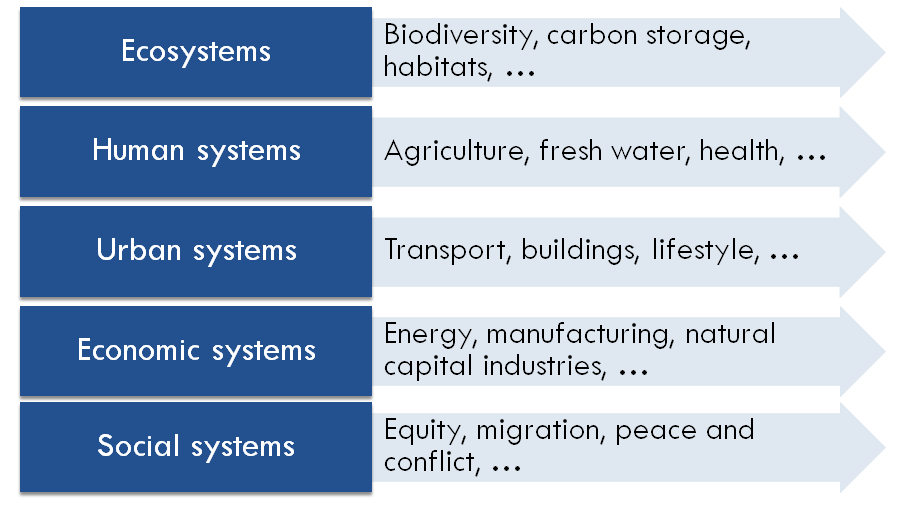
Useful in outlining the difference between global warming and climate change.Great way to slowly introduce a systems approach to geography which is very much a key element to A Level geography.
Effects of climate change on people and the environment.
When planning the resources for this element of the course, I shall be using elements of the video that has been included in module 1
3.00 minutes into the video is an excellent section on how climate change has affected the cryosphere and lasts about a minute. From 4 minutes in, the role of the oceans is also discussed.
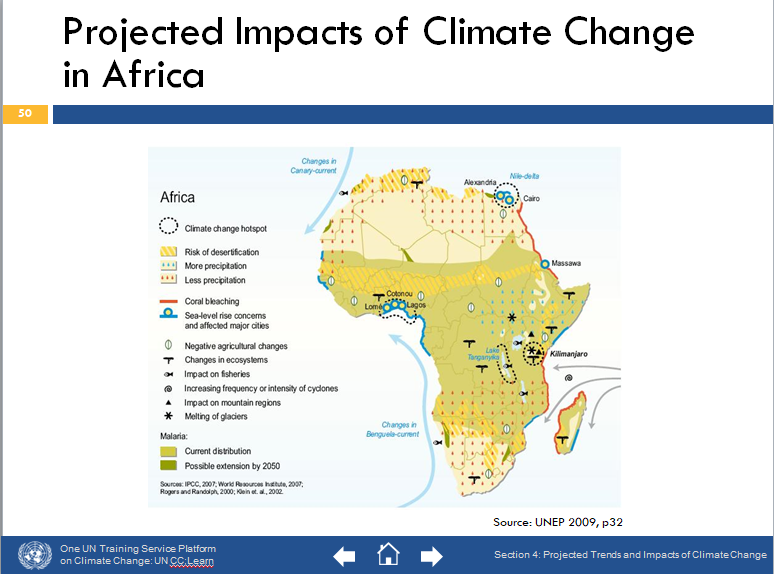
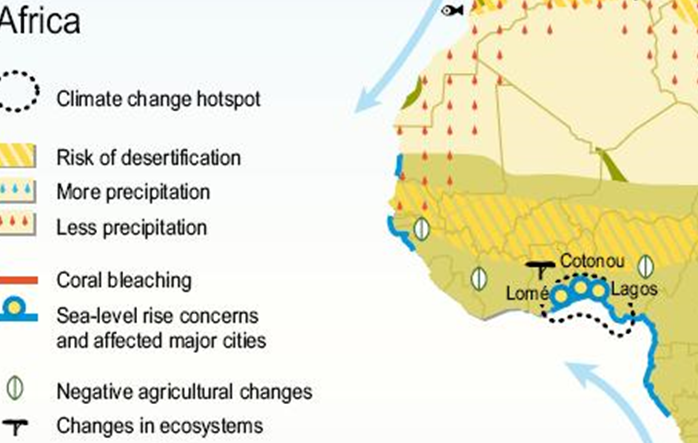
I shall also be using these excellent maps from slides 50 to 52 to highlight through later case studies how climate change will affect the places we study. For example, when investigating a NEE – Nigeria we shall refer back to the map below as climate change will play an important role in areas such as Makoko – the floating settlement area of Lagos.
By highlighting key locations or case studies now, I am hoping that the students see the world, and their studies as connected places – so developing their ability to “think like a geographer”
Once I have finished the powerpoint I shall post here. I would love to hear what you think so far.
I am always keen to read, learn new knowledge and hopefully better understand the world around us. I guess that is why I decided way back in 1991 to undertake a university degree at what was then called QMW, Queen Mary and Westfield College, University of London. Thank you @QMULGeography
After graduating, I decided to train to become a teacher, and 22 years later I am still a geography teacher! How time flies!
As a teacher, my main task is to develop students knowledge and understanding, and so personally it is important that I also have the same focus. I want to keep on learning and exploring new ideas, it is what drives my passion for teaching and for geography.
So back in May, I came across a Tweet from Ben King, @benking01, explaining that he was undertaking a UN course on climate change. Now as with many things on twitter, a few clicks later and almost an hour had passed, as I explored what the UN course was and how it might have an impact on my teacher.
Here is what I discovered…
The course is free CPD
There are 5 modules to complete these are:
UN CC:Learn “Children & Climate Change” Course
UN CC:Learn “Cities and Climate Change” Course
UN CC:Learn “Human Health and Climate Change” Course
UN CC:Learn “Gender & Environment” Course
UN CC:Learn “International Legal Regime of Climate Change
Each course has a range of materials for you to use and learn from. This ranges from interactive powerpoints, PDF handouts videos and then to check your learning a quiz for each module. The quizzes are multiple choice generally, but do relate to quite specific detail, so they require time to think about the answer. Each quiz is allowed to be taken up to 3 times, and you need to achieve a score of 70% to pass.
The detail in each course is excellent and for a geography teacher very helpful in bringing the subject of climate change to life, with the modern and up to date case studies which when I use them in the classroom will bring further depth and relevance to the subject.
For example, I use tropical storm Haiyan as a case study of a tropical storm at GCSE. Within the gender module, the course highlights how women were affected by the tropical storm compared to the men. Really eye opening stuff and something I shall ensure I use next year when teaching it next.
The module that I found the most interesting was the gender module, as it really highlighted differences that geography and climate change can have on men and women, something that is perhaps overlooked in my classroom. The International Legal Regime of Climate Change was the hardest module, as there was a lot of legal technical information to remember. However, it also highlighted why global governance is now taught at A Level Geography.
I look forward to developing resources further as I develop my climate change scheme of work at GCSE and the Global Governance SOW at A Level.
I am new to blogging, so be kind. I am doing this to record my developing thoughts on my teaching practice and research. I aim to post something each week, so sit back and enjoy the read!
Good company in a journey makes the way seem shorter. — Izaak Walton




 Geographical reflections