I am always using Twitter or Facebook groups to see what I should be reading, and last week I came across Kate Jones’s twitter feed @87History and her book focusing on retrieval practice.

I am currently focusing on my Year 11 and Year 13 students as they prepare for a series of assessments in order for their final grades to be awarded this year, so felt that it was a good time to be revisiting retrieval practice.
Kate’s book is very easy to read, one of those books that you start and you get half way through without realising it. The book is great for ITTs that have essays to write as Kate uses chapter one to summarise the key elements of research behind retrieval practice. I found this chapter really helpful as the links are there so you can go off and read the research yourself, and it helps to keep your own teaching practice current and research based.
On page 25 there is a wonderful image – below – that Kate has used to summarise the “teaching and learning puzzle” which I shall be using next year when I start mentoring my Geography ITT. It really does highlight the many different aspects there are to being a teacher!

With trying to support my Year 11 and Year 13 classes in revision for their assessments, I wanted to really grab some different ideas for use in the classroom and chapter 2 had a really great idea Kate calls the “retrieval practice placemat.” (p76) Kate has created a generic series of questions for the students to use when retrieval practice is required. Laminated and placed on desks, it is easy to put together but really powerful. Kate has a template on TES you can download for free here
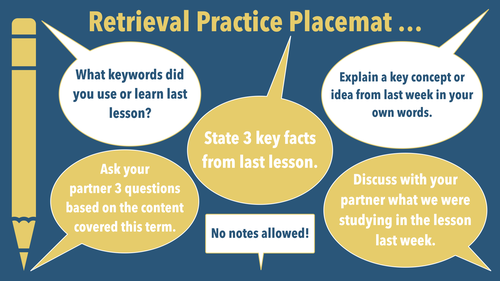
The fact that the statements are generic means that you can use the placement in any lesson, with any year group – so a real workload saver!
I decided to create my own version with the focus on geography. So for example I have included a statement about drawing a labbelled diagram, and retrieval on case studies as well.
The key is not to use the placemat all the time but to vary the retrieval practice diet, so I am planning on using this once a fortnight or so along with other methods.
I decided to use icons as well as text to develop duel coding into the document as well.

One technique that worked really well with my GCSE group was the “Brain dump” idea that Kate discusses on p77. I placed six words on my first PowerPoint slide and gave the students 10 minutes to write as much as they could remember about one of the words.
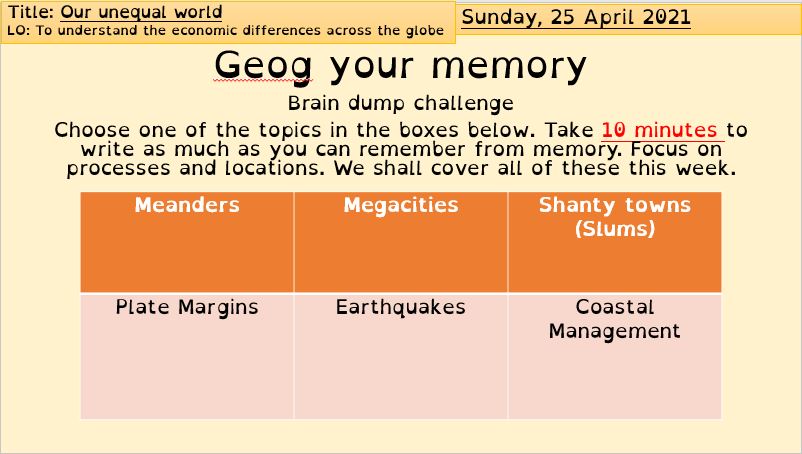
We had six lessons last week, so at the start of every lesson, we turned to the back of the books are wrote for 10 minutes on one of the words. I decided to use spaced practice as well, by using terms from topics that were covered a few weeks, a few months and a year ago. When we have our next lesson, I shall be giving the students a summary from the textbook / revison guide so they can see how much they have remembered, and using a purple pen, add areas that they had forgotten. One student in particular saw this and said straight away – “I can’t remember anything”. A few “are you sure” questions and a few begining letters for the plate margins and 10 minutes later there was 1/2 a page written! It was really pleasing to see the satisfaction and pride in the faces as students realised how much they did remember!
There are lots of other ideas in the book, such as revision clocks, challenge grids and walkabout bingo which I look forward to trying once we can have students moving around the classroom again.
At this time of year, we often ask students to revise for their exams, but perhaps by embeding retriveal practice into lessons through KS3, KS4 and KS5, the need to “revise” for the big exams becomes less about cramming and more of a retrieval habit.
We don’t want the first time that students recall information being their exam!


 This allows the students to see the overall lesson plan and road map of the lesson, and when writing it, allows you to see if there are any pitfalls.


 Geographical reflections